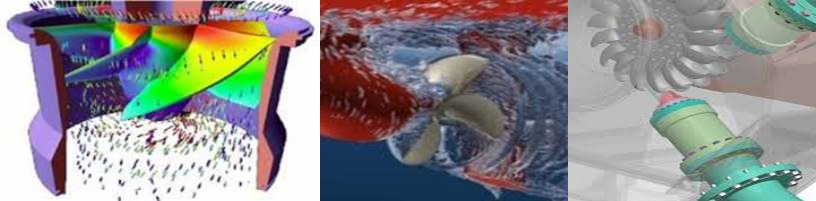
MFLOPS will develop accurate simulation methods and tools for multiphase flows, couple them with efficient optimisation methods and demonstrate their capabilities for the effective design of a wide range of industrial applications: hydraulic turbines (Kaplan, Pelton), marine propellers and marine vessel hydrodynamics, fuel cells, high-pressure injectors for E-fuels, cooling systems for compression-ignition engines and immersed BTMS.
These research areas align with Horizon Europe work programme objectives for Climate, Energy and Mobility and address the United Nations goals for ‘Affordable and green energy for all’.
The research objectives to be addressed in the corresponding three work packages (WPs) are as follows:
WP-1: To develop physical models and optimisation methods for cavitation, erosion and noise, aiming to assist in the design of (i) hydraulic turbines (Kaplan and Pelton) and (ii) composite material marine propellers. These will assume isothermal flows and will involve both gradient-based and gradient-free optimisation, based on the complexity of the physics and the computational cost.
WP1: Cavitating flows and free surface flow in hydro turbines and propellers
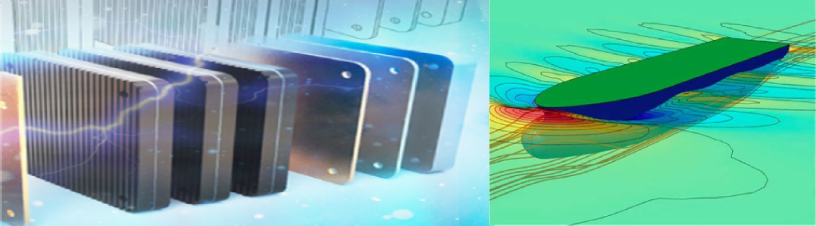
WP-2: To develop physical models and optimisation methods for immiscible liquid flows and apply them to the design of (i) low-temperature PEM gas diffusion layers and flow passages of the graphite plates utilised in fuel cells and (ii) power/drag-optimised merchant ships and their propeller integration.
WP2: Immiscible fluids flows in PEM FC microchannels and marine vessels
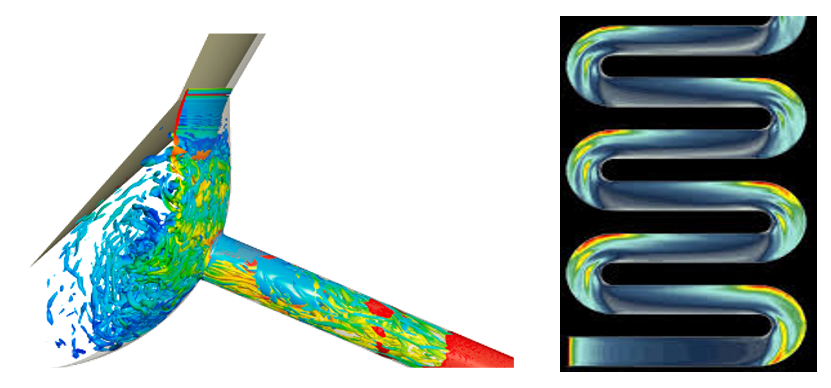
WP-3: To develop physical models and optimisation methods for flows involving boiling or supercritical phase- change and heat transfer and aiming to the design of (i) high-pressure fuel injectors utilising e-fuels, (ii) submerged BTMSs for EVs and (iii) cooling systems for heavy-duty Diesel engines.
WP3: Two-phase flows with real-fluid EoS and applications to e-fuels and cooling systems
In each research WP, a specific type of multiphase flow will be considered. The DCs will implement relevant physical models that will be integrated with the corresponding optimisation strategies. Validation against experimental data will be based on existing test cases, provided by the industrial beneficiaries, and associated partners, for well-documented simplified geometrical layouts and will be two-fold:
validation of the relevant physical models against available experiments and
(ii) verification of the effectiveness and efficiency of the chosen optimisation strategy. The developed computational routines will be suitable for implementation to the various CFD codes available in the MFLOPS consortium, and which include a wide range of opensource, inhouse and commercial CFD platforms: OpenFOAM, PUMA, ASPHODEL, ANSYS-Fluent, CONGERGE, RE/FRESCO and AVL-FIRE.
More specifically the network will develop models for cavitation erosion (DC*1 and DC11), droplet nucleation and transport in the catalyst/GDL of fuel cells and general immiscible flow modelling (DC4, DC5, DC12), phase-change simulation from transcritical to supercritical P-T conditions (DC7, DC13) and nucleate bubble boiling (DC9). Existing open source CFD solvers (such as OpenFOAM) will be extended/enhanced to accommodate fluid-structure interactions for composite materials (DC3) and the extension of the SPH methodology suitable for Pelton turbine simulation to account for cavitation (DC11). In addition, the optimisation methods that will be developed for the above processes (DC2, DC6, DC8, DC10, DC14) address time-dependent multi-phase flow configurations that are currently not available. Finally, these optimisation strategies will address real-world industrial applications that have never been attempted before.